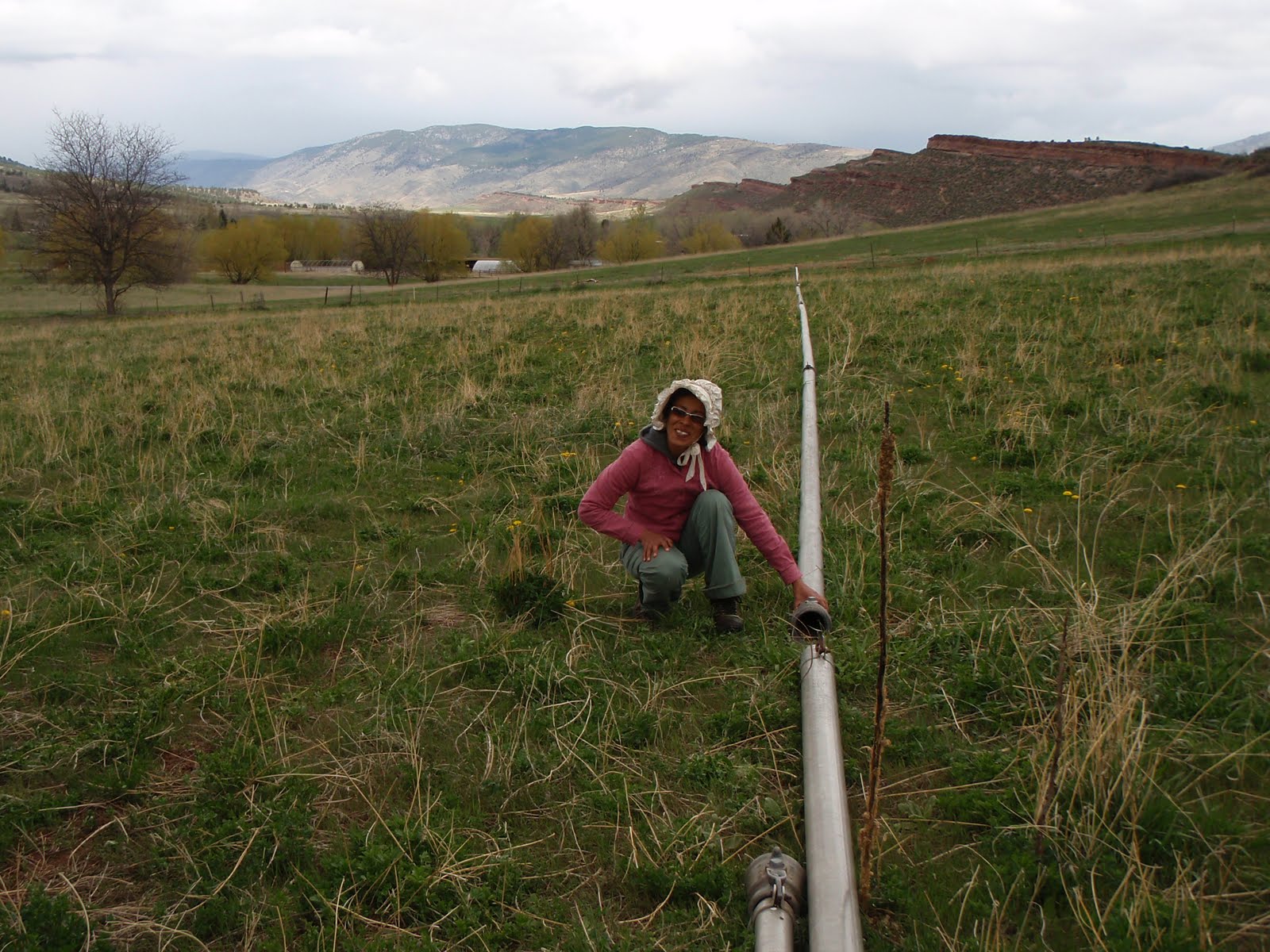
Thursday, June 24, 2010

The time has come

Cow 'harvest' tomorrow. Not sure if I'll be able to watch the entire process...or have to peak through my fingers like watching a scary movie...or maybe just become vegetarian after this.

For tonight the five largest cows are happily sorted from the rest, and eating up lots of grass and hay in a pen for their last meal under the starry night sky. I haven't gotten close to the cows in the past few weeks, just because work in the garden has been so busy that others have tended to the cattle. But there are definitely a couple cows in this bunch that we've bonded with, just because they look more unique from the rest of the herd.

None of us interns need to be there for this harvest, but we all feel that it is important to see our food from start to finish. We've seen these cows frolicking in the pastures...eating happily...staying healthy...loving life. I think they've lived life to the fullest!

Here are some photos of sorting cows this afternoon:


Sara waiting to let the small ones out of the pen.


Michael directing cow traffic.


Kate watching with a heavy heart.

Monday, June 14, 2010

seeds of our past

Apologies for those of you who have been holding your breath waiting for a new post! :) It's been a crazy busy couple weeks and oh so much fun! Yes, LOTS more weeding and transplanting that wasn't much to write home about anyway...but outside of the farm I put some miles on my bike, learned how to change a tire (after a couple flats nearly left me stranded :), have met a lot of great people, and I saw my first show at Red Rocks! Tom Petty just happened to be playing on my birthday and I got to spend some time with family. My dad was in town too, so I was able to show him around the farm and hear stories about the family farm. I found out that we used to have a milking cow and would make our own butter. Sure, buying it at the store today is much more efficient, but what an amazing accomplishment to be able to make that and truly appreciate the results!

Our seed saving class this week went from complicated to emotional. We learned the difference between heirlooms, hybrids, F1, open pollinated, and modern plants. I still don't completely understand them all (I never aced biology!), but I did learn a very important lesson: It is our obligation to pass along our family stories and cultures by continuing to buy and eat plant and animal varieties that our ancestors brought over to this country. We should support organic seed companies that offer many unique varieties. Otherwise these varieties and old world cultures will fade out like endangered species. Most gardening seeds actually come from Monsanto and we don't want to support their GMO seeds...check out this overwhelming diagram of Monsanto's umbrella. Although Europeans can save seeds, US, Canada, Australia, and New Zealand are the only places where we have the freedom to buy seeds and grow for ourselves. And who's to say how long that will last if GMO seeds run the world. Doesn't that seem scary?

So if you're going to buy seeds, check out some independent places like these next time. Try some green and purple cauliflower or any crazy heirlooms!!
Baker Creek (rareseeds.com)
Wild Garden Seed (wildgardenseed.com)
Fedco (fedcoseeds.com)
Seeds of Change (seedsofchange.com)
Seed Savers Exchange (seedsavers.org)
Turtle Tree Biodynamic See Initiative (turtletreeseeds.com)
Abbondanza (eatabbo.org)

Thursday, May 20, 2010

planting potatoes

The mission for the past few days has been planting potatoes! I might have to join a body builder competition after this with all these muscles! :)

First we tilled a bed with 50 foot rows, then we dug trenches and mounds. We currently have dug about 20 rows...hopefully that's enough!


The potatoes need to be planted deep within these mounds so that they do not surface and turn green, otherwise they will be poisonous.


What kinds of seeds do we use, you ask? We cut up old potatoes into sections, each section containing an eye where new growth with form. I can't imagine how many pounds of potatoes we're going to harvest just from a few bags of old potatoes!

After planting some of the potatoes, we've mulched the mounds and trenches with straw. I kept calling it 'haaayyy,' but apparently hay is made of more leaf parts and grasses and used to feed horses, whereas straw is the stalk of wheat, rye, and other such grain plants. So much to learn!

Thursday, May 13, 2010

funny what we can adjust to

People think this should be a drastic change of pace for me, or perhaps this experience should be different than I expected, but neither is the case. I enjoy the hard work and I guess not much bothers me.

A few things have crossed my path that are becoming second nature to me:

1. Colorado's weather flux. mornings start with a vest, raincoat, thermals, and sweatshirt for some snow, and the day ends in a tank top and jeans.


2. composting toilets. I used to flip out when I was a kid, thinking I'd fall into the dark pit. But now it's pretty cool...especially when the water shuts off in our apartment.

3. mothers nursing in public

4. spiders. everywhere! Sure, not so much fun to see at night on my bed, but knock on wood...I haven't seen a Chicago-style silverfish/millipede thing scurrying around yet, which are much faster runners, therefore much scarier in my mind.

5. snakes, owls, elk


6. unagressive drivers driving below the speed limit, and not merging very efficiently

7. being the only girl who's unafraid of razors, LOL

8. no pop. no rye bread.

I'm sure I can add more later, but that's that for now!

predators vs. prey

Tuesday morning was just another early morning irrigation pipe change until we heard shots and saw smoke! It was cannon shots from our neighboring raspberry farmer, who was attempting to scare the elk from his crops. Now that our little valley area is free of large noisy farming equipment, wildlife have made their way back into the area. So when someone pointed to the elk, I almost didn't turn around...it's like seeing skyscrapers in the big city...I've seen my share. But when I finally did look I thought I was on the set of the discovery network. There was a serious GANG of elk. Hundreds! Flowing like water over a broken dam, they ran across our pastures and up into the hills. This probably doesn't compare to any of the herds in Africa, but it kinda felt like that here. See if you can spot them in this first photo:


That went along well with our class session today on rotational grazing, which we are doing with the cows. When we rotate our cattle to the next field, we are mimicking what happens in nature. Ruminants (cows, bison, elk, etc) both stay in herds and move locations to protect themselves against predators (wolves, lions, people, etc). So when the cows stay in one place for too long, they will overgraze, which means that the grasses will not have the proper energy in their root systems to regrow, creating bare land (and bare land is bad!). Even 'free range' is not the best approach to raising cattle because the cattle could still spend too much time in the field and overgraze.

After Yellowstone reintroduced wolves to the park, the elk population was reduced, grasses and trees were no longer overgrazed, more birds and bugs grew in the trees, beavers found more twigs for dams, therefore many more species were brought back besides just the wolves. Pretty awesome how nature works so naturally, huh? Our jobs as 'super grass farmers' are going to be to get the land back to how it was covered in grasslands so the grasses can properly soak up water and add carbon nutrients to the soil. Maybe someday our team will come out with a comic book: Super Farmers vs. Bare Land. hha...

Monday, May 10, 2010

week one recap

Since I started working, it's been pretty nonstop, so I'll give some highlights going back to last week:

Friday (day 2):
- woke up to a couple inces of snow! this is ok for the crops we have out (peas, root vegetables, and covered lettuce/spinach). we're still in danger of frost until May 15. Frost is actually more damaging than snow since the ground is frozen, whereas the air can be cold but the ground can still be warm with snow.


- ate some rhubarb straight from the garden. tart, but somewhat addicting to eat...like sour patch kids. later that night our garden manager marinated rhubarb for a few hours in water with some cinnamon, ginger, cloves and similar spices, then drained and served. very tasty!


- weeded the onion patch for the rest of the morning. the grass weeds we were pulling looked nearly identical to the small onion shoots, so it was no easy task!


Saturday (day 3):
- repaired the barbed wire fences. having lived in the birthplace of barbed wire (DeKalb, IL) this reminded me of home. I'm impressed that us women outnumbered the men today, 4 to 1! guess we're pretty tough chics...


- I hesitate to say I was homesick...but I was craving some time with some friends off the farm, so got to spend the night with friends in Denver. just what the doctor ordered!

Sunday:
- checked in on the greenhouse periodically throughout the day. The plants in the greenhouse are more sensitive than those outside, so the greenhouse needs to stay between certain temperatures and the plants inside need to be well hydrated. It's no wonder farmers are such hard workers...they can't take many breaks from the farm! But I suppose 7 days of satisfying work outweighs living for the weekends and vacations.

Monday:
- compost day! We took a week's worth of the kitchen's compost and dumped it next to the chicken dome. They eat some of the scraps and shuffle through the compost and dirt to find and eat little bugs and worms. so cute!


- planted 7 trees in the permaculture garden. We had to take a pick axe to the tough Rocky Mountain clay!


- weeded the garlic, then surrounded them with hay for insulation and weed prevention. This took the rest of the afternoon!

Thursday, May 6, 2010

first day on the job


6:30 AM and we were out on the chilly morning fields, realigning the irrigation pipes, aka 'pipe change'. They aren't heavy, it just takes some logic to move them on the field while sidestepping the sprouts and logic to piece them together properly. It's a fun group activity nonetheless, as the farm crew was all hands on deck.

On our truck ride to the next mission we spotted horned owl in a tree...THEN saw a bull snake trying to swim to safety out of the canal. It couldn't gain friction on the cement, so a couple brave souls grabbed it out with a couple of plastic fence posts. Bull snakes aren't harmful to humans, and in fact eat rattlesnakes, so we want to keep them around. What a jungle around here!!


The next mission was moving the cow fences. The cows are moved to a fresh pasture every morning. When I first imagined how we would be herding cows, I thought it would be like the wild west movies and I could be the cowgirl, riding the horse into the sunset...while herding the cows, of course. When I realized that there weren't horses here, I thought, perhaps we pushed them? or rang a cowbell? Is that what cowbells are for? Nope...I was way off. So the cows are pretty well done grazing a field within a day before they get hungry again. And once they get hungry they moo, and when they are hungry and see us farmers, they really moo! We don't even need to really call them, they all just bolt down the field to us and wait for the gates to open to the new field. The fence is just a line of electric wire that we string up and move. And the cows are so well trained that they won't go within a foot of the wires. When they first gallup into the greener pasture, they go to town! Their tongues hit the tallest grasses first, so they devour that, then they'll start eating the other types of plants - clover, alfalfa, dandelions, etc.

Apparently the soil here in Colorado is terrible, so grazing cows like this really helps the land. The cows are like lawn mowers, clipping the grass and making it grow to be a stronger plant (as long as the cows move daily, otherwise they'll eat too much of the grass and it won't have enough energy to grow back as quickly). They also leave their lovely manure evenly scattered around the field, providing nutrients, as well as providing a means of moving grass seeds from one field to another without the farmer having to replant seeds. We're mocking nature moving grassfed cows this way...funny how nature works so well, huh?


After lunch I worked with the garden manager in the greenhouse, transplanting tomato plants into larger containers. Some of their leaves were curled and dried, others were turning yellow or purple. This could be from the cooler weather, or from nutrient deficiency. Either way, I know my tomato plants back home had looked a little sickly like this too but i'm not sure I had ever fully saved them. So I hope I was the right person for this job!! However, I learned that the key to transplanting the tomato is to nip off the first set of the leaves (the seed leaves) then turn the plant on its side, bend the stem upward, then replant, making sure to bury the entire stem up to the first leaf node. The roots seem to grow sideways but then they don't run out of room at the bottom of the container. The soil we transplanted with was just store bought soil mixed with a bit of worm castings. And best of all, no chemicals!! The tomatoes will stay in the greenhouse since the weather here is chilly.

Even with 300+ days of sunshine it's actually still pretty cold - and makes for a short growing season. How can so many people here be organic then, I wonder?? Perhaps I should have stayed in the midwest where the topsoil is forever deep and where there are day-long thunderstorms! While Chicago's been in the 70's for the past week, it's been 50's here - and it looked like there would be huge storm this afternoon but it barely sprinkled. hha. Yup, and the biggest shock of all...the Chicago girl was even prepped for the temps with rain boots, carhart sweatshirt, and raincoat...and comes with camping experience! Chicago, you can thank me later for giving you a good name...